
Client Background
Client Name: Confidential (Cybersecurity & Communication Platform)
Industry Type: Cybersecurity / SaaS Communication
Products & Services: Secure messaging platform with real-time communication and threat monitoring
Organization Size: 40+
About Client:
The client operates in the secure communications domain, offering real-time messaging services for organizations that require strong identity verification and protection against insider threats and cyber attacks. Their existing system relied on traditional login-based authentication, which was insufficient for continuous identity assurance and real-time threat detection.
The Problem
The client faced several critical challenges:
- Session Hijacking Risk: Once logged in, there was no continuous verification of the user.
- Insider Threats: Unauthorized users could misuse active sessions.
- Weak Behavioral Security: No use of behavioral biometrics like typing or mouse patterns.
- Lack of Voice Verification: Voice messages could not be authenticated.
- Spam & Attack Vulnerability: Group chats were exposed to spam and malicious traffic.
- No Real-time Threat Detection: Network-level anomalies were not monitored effectively.
This created a gap between authentication and actual user behavior, increasing security risks.
Our Solution
We developed a multi-modal security platform combining:
1. Continuous Biometric Authentication
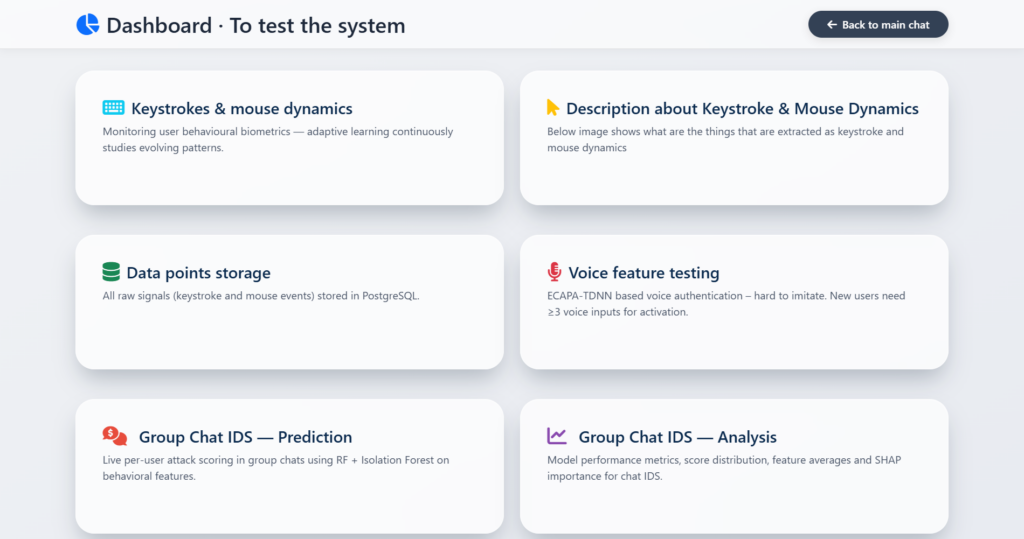
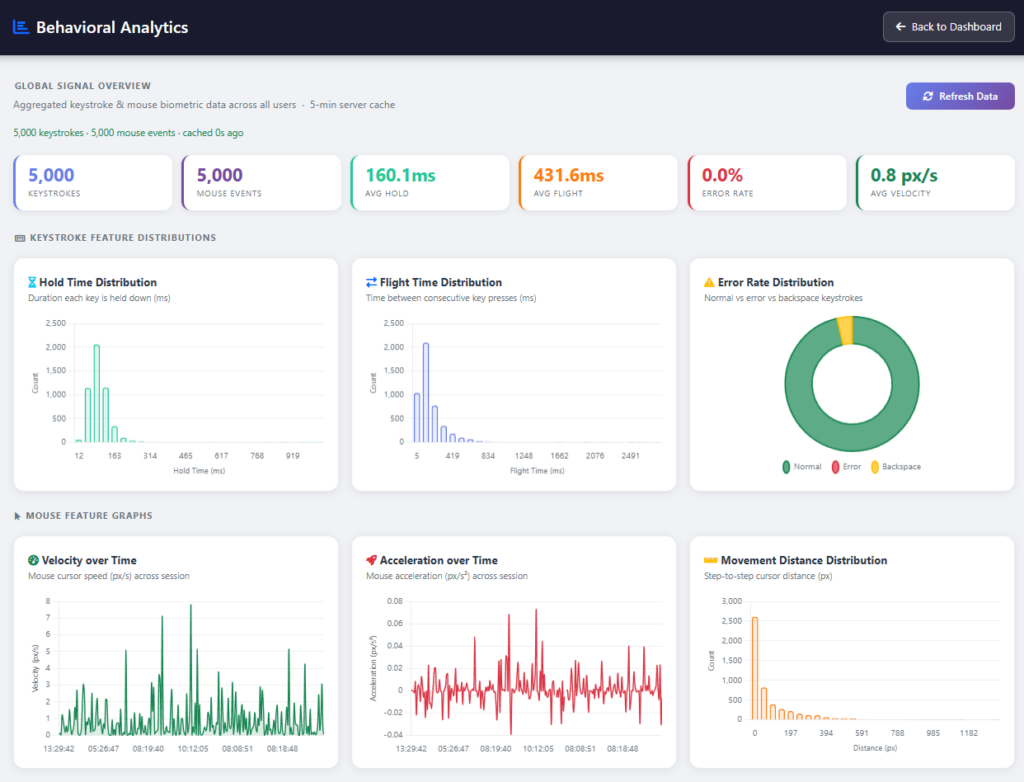
- Keystroke dynamics (typing behavior)
- Mouse movement patterns
- Real-time identity verification using BiLSTM models
2. Voice Authentication System
- Speaker verification using ECAPA-TDNN embeddings
- Automatic enrollment and similarity-based validation
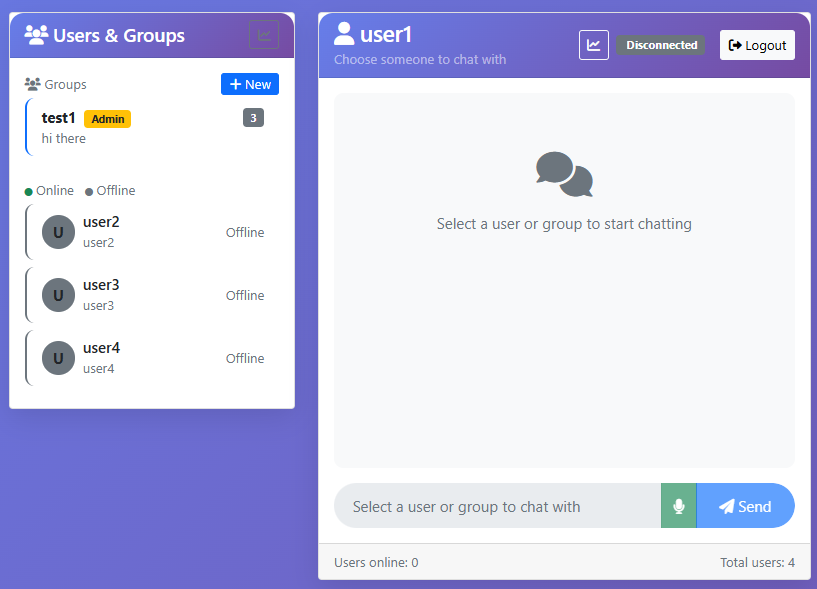
3. Real-Time Chat System
- WebSocket-based communication
- Integrated authentication checks during active sessions
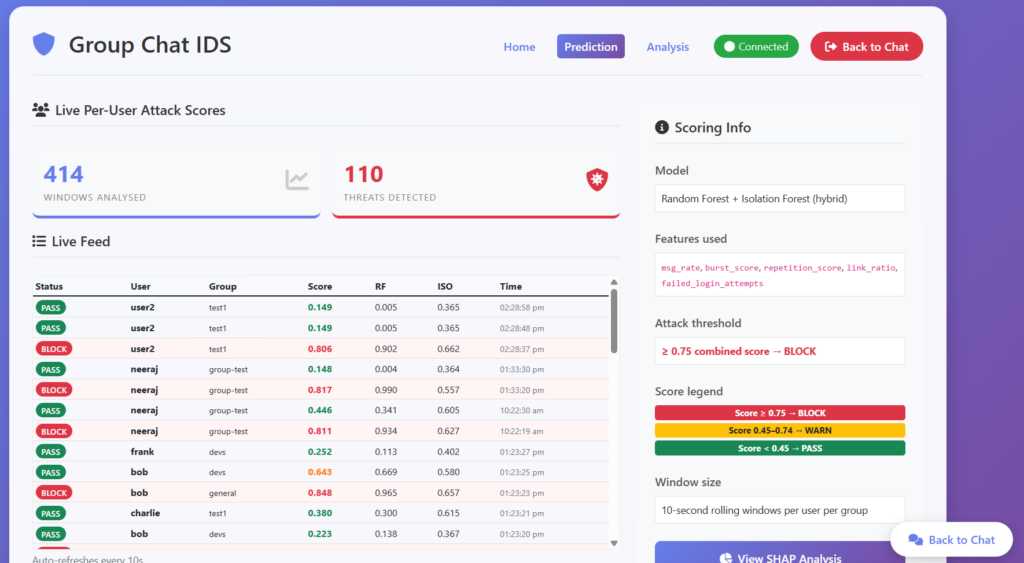
4. Network Intrusion Detection System (NIDS)
- Hybrid model:
- Random Forest (known attacks)
- Isolation Forest (unknown anomalies)
- Real-time monitoring and alerting
5. Adaptive Learning System
- Models retrain automatically using new behavioral data
- Improves accuracy over time without manual intervention
Solution Architecture
The system follows a multi-layered architecture:
- Frontend Layer
- Captures keystroke, mouse, and voice data
- Sends batched behavioral data to backend
- Backend Layer (FastAPI)
- Handles authentication, chat, and processing
- Runs behavioral verification models
- Manages user sessions and strike logic
- ML Layer
- BiLSTM models for behavioral authentication
- ECAPA-TDNN for voice embeddings
- Ensemble ML models for intrusion detection
- Data Layer
- PostgreSQL for behavioral data
- SQLite for chat and messages
- Real-time Communication
- WebSockets for instant updates and alerts
Deliverables
- Secure real-time chat application
- Continuous authentication system
- Voice verification module
- Network intrusion detection dashboard
- Adaptive ML training pipeline
- Admin dashboards and analytics
Tech Stack
- Framework used
FastAPI, Flask, SocketIO
- Language/techniques used
Python, JavaScript, HTML/CSS
- Models used
- Bidirectional LSTM (behavioral biometrics)
- ECAPA-TDNN (voice recognition)
- Random Forest + Isolation Forest (NIDS)
- Skills used
- Machine Learning
- Deep Learning
- Real-time systems design
- Cybersecurity engineering
- Databases used
PostgreSQL, SQLite
- Web Cloud Servers used
Uvicorn (ASGI server), Flask server for NIDS
What are the technical Challenges Faced during Project Execution
- Real-time processing of behavioral data without latency
- Designing accurate biometric models with limited user data
- Handling asynchronous voice processing
- Avoiding false positives in authentication
- Integrating multiple ML models into a single pipeline
- Ensuring scalability for concurrent users
How the Technical Challenges were Solved
- Implemented batch processing for keystroke and mouse events
- Used BiLSTM models for sequence learning and better accuracy
- Introduced adaptive retraining pipelines
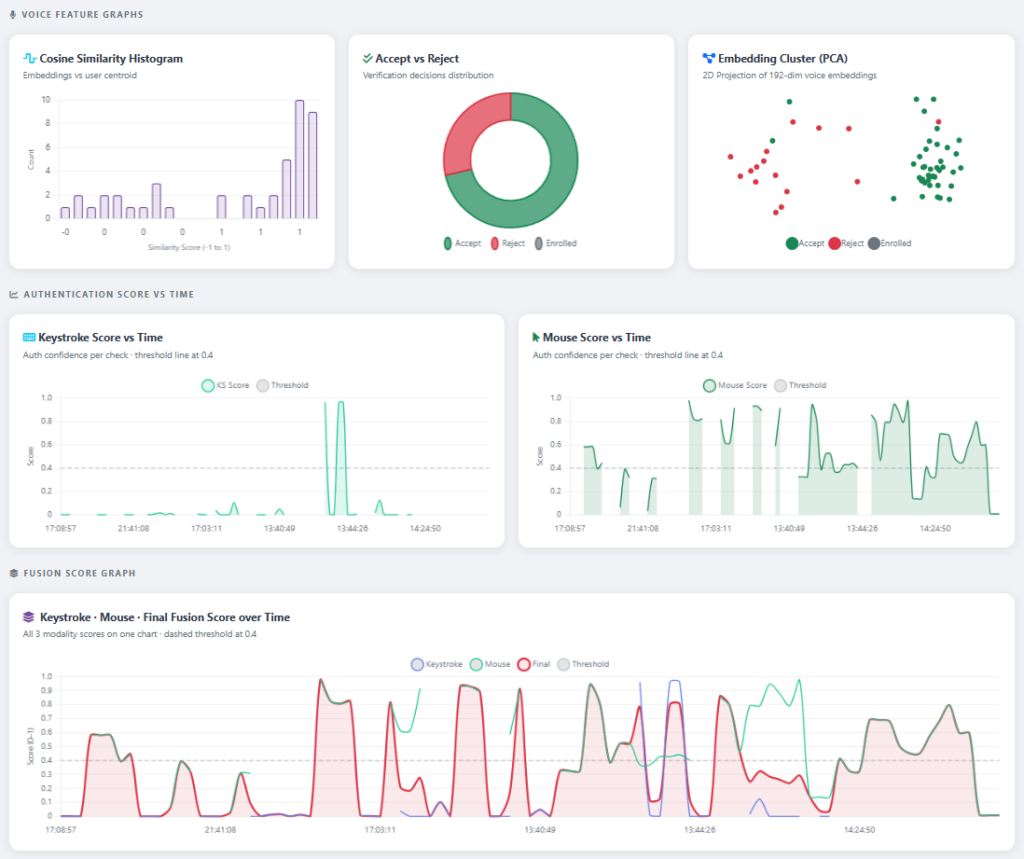
- Applied threshold-based decision fusion (70% keystroke, 30% mouse)
- Used background workers and thread pools for non-blocking processing
- Combined supervised + unsupervised models for robust intrusion detection
Business Impact
- Enhanced Security: Continuous authentication reduced unauthorized access risk
- Improved User Trust: Real-time identity verification increased confidence
- Reduced Fraud & Abuse: Immediate logout on suspicious behavior
- Scalable Architecture: Supports multiple concurrent users and real-time processing
- Intelligent Threat Detection: Early detection of anomalies and attacks
Project Snapshots