

Client Background
Client: A leading tech firm in the USA
Industry Type: Private Equity & Financial Research (Corporate Finance and Investment Governance)
Products & Services: Empirical analysis of private equity buyout contracts
Organization Size: 100+
About the Client:
The client is an academic researcher / doctoral candidate conducting advanced research in the field of private equity and corporate finance. The research focuses on private equity–backed buyout transactions, with particular emphasis on governance structures, contractual design, and incentive alignment between investors and management teams.
The Problem
- In private equity (PE)-backed buyouts, investors and management teams enter into complex contracts that define how control, decision-making, and financial rewards are shared. However, there is limited understanding of how these contracts are designed in practice and how they vary based on factors like management ownership, fund type, or risk-reduction strategies.
- This dissertation aims to fill that gap by analyzing real-world PE contracts to answer key research questions about how contract terms influence governance, reduce conflicts, and align the interests of investors and managers in buyout transactions.
key research questions / Problem Statements
- How are control rights and manager ownership connected to the number of contractual rules?
- How common are alignment clauses (like co-sale and tag-along) at different ownership levels?
- How does transparency (e.g., reporting duties, veto rights) vary with manager ownership?
- What is the link between board structure, meeting frequency, and ownership stake?
- How do extra control rights (like veto power) impact exit success?
- How do different security types affect cash flow rights and fairness (e.g., envy ratios)?
- Does the exit timeline depend on contract clauses like tag-along and drag-along?
- Do investor types (banks, families, independent funds) use different contract rules?
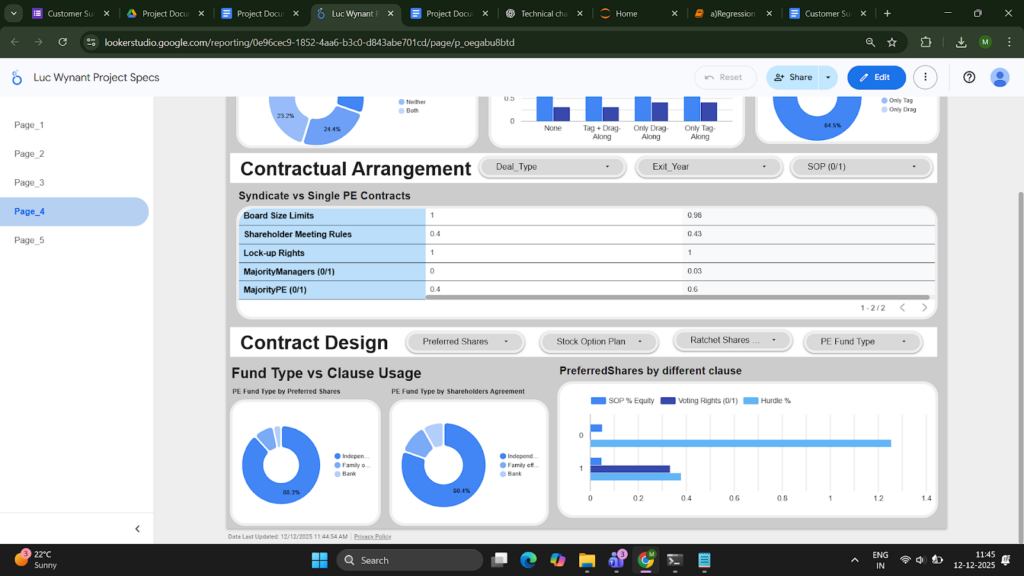
- What are the main contract differences between solo PE investors and syndicates?
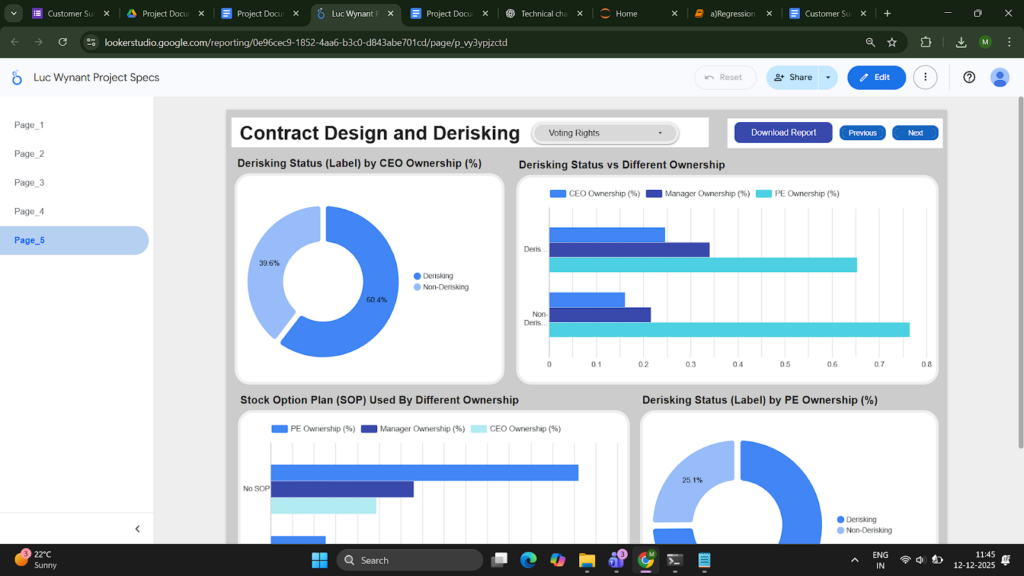
- How are contracts different for firms aiming to reduce financial risk (derisking strategy)?
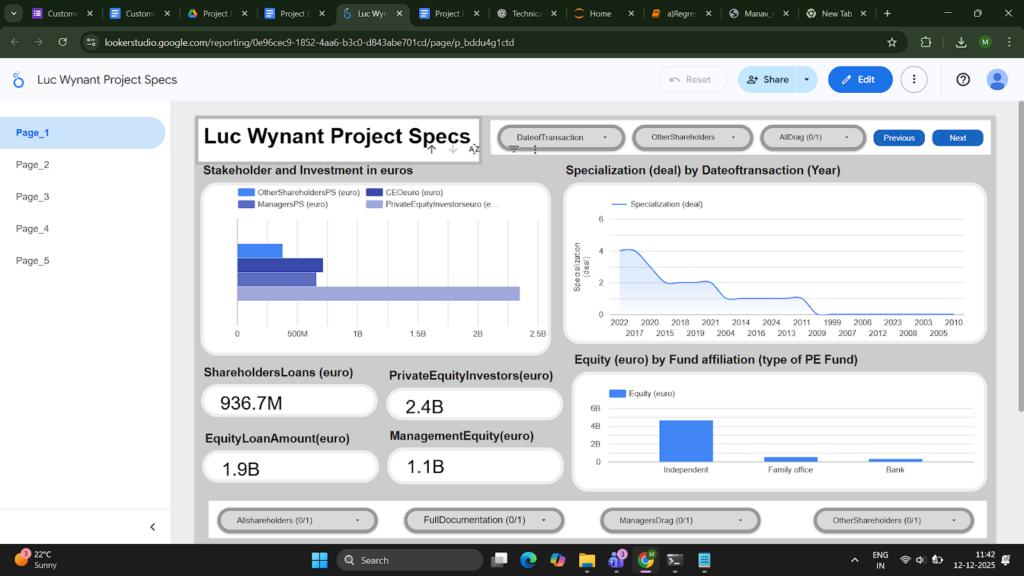
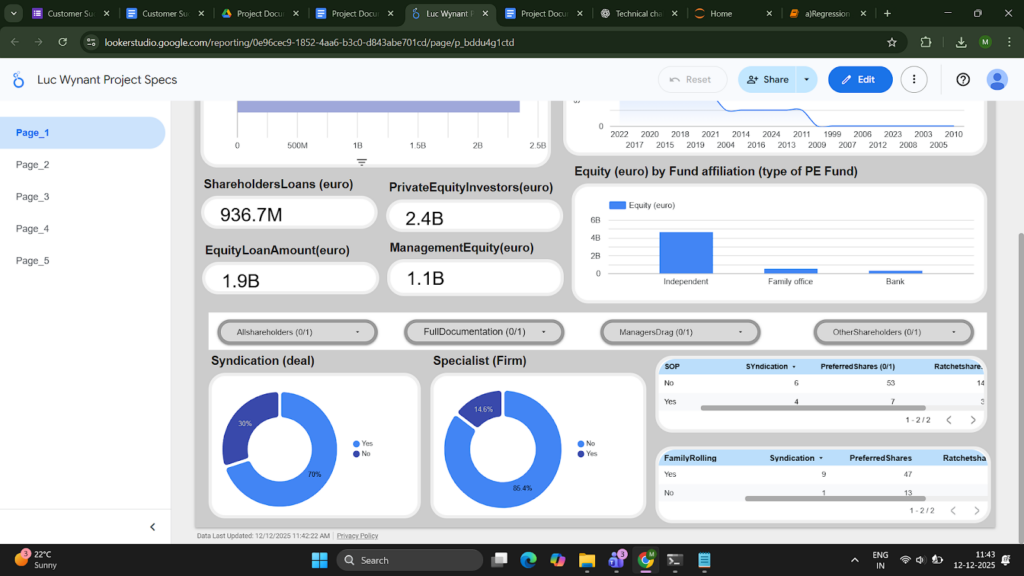
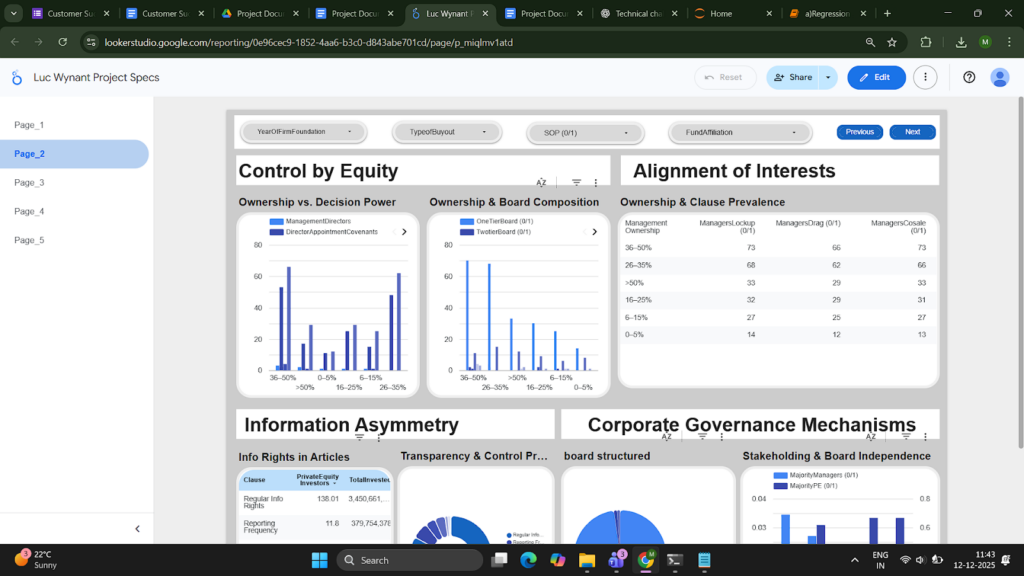
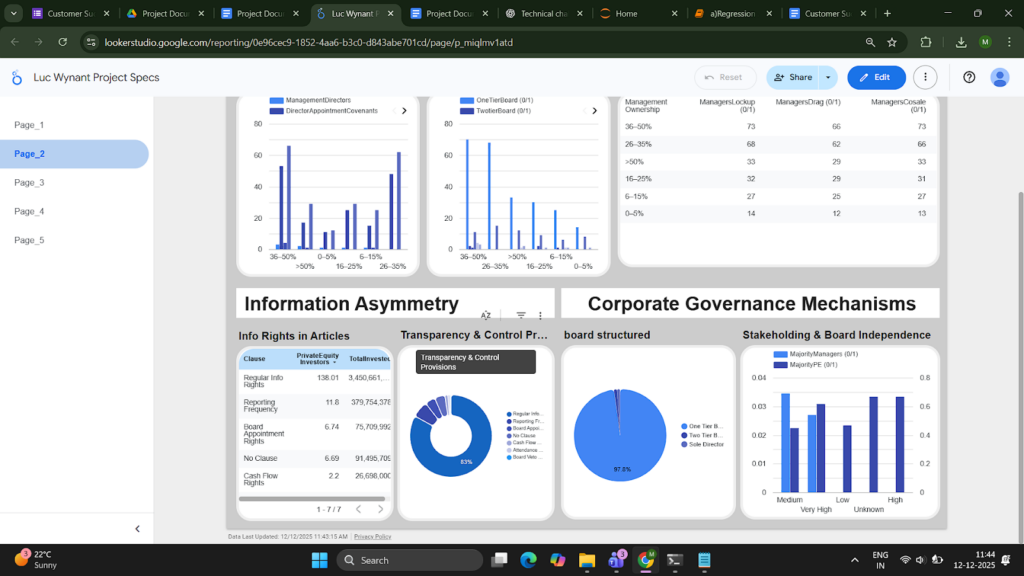
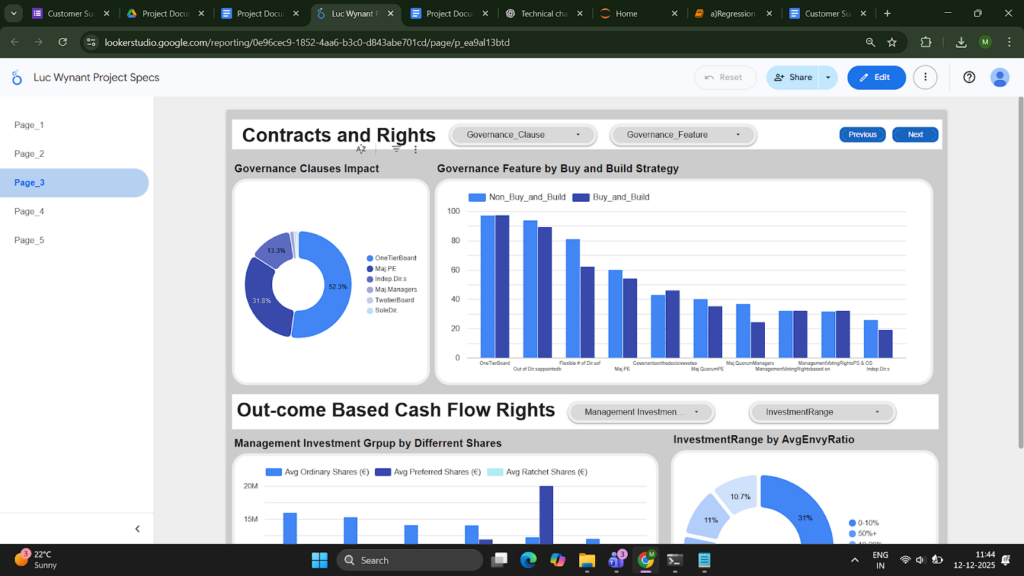
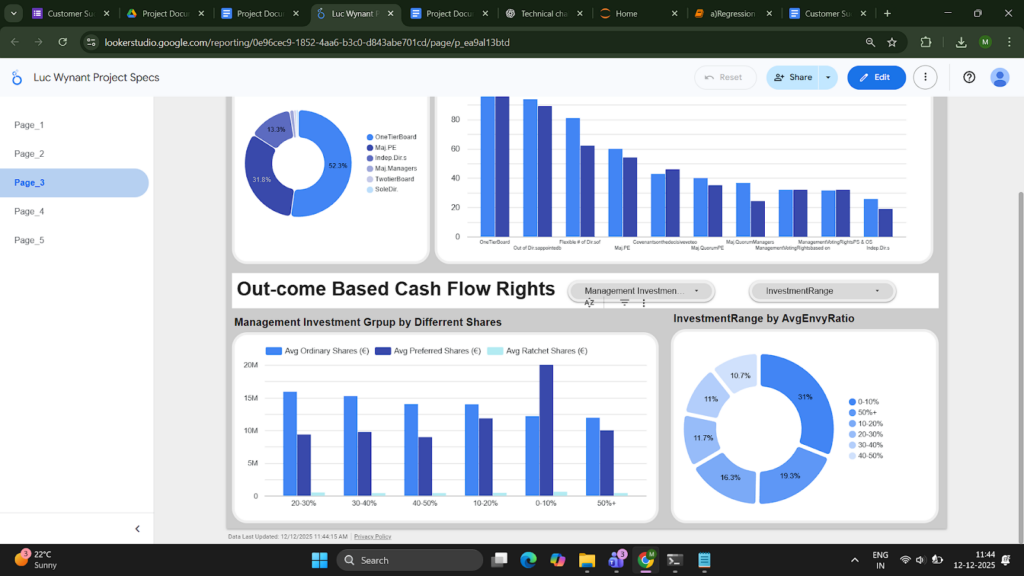
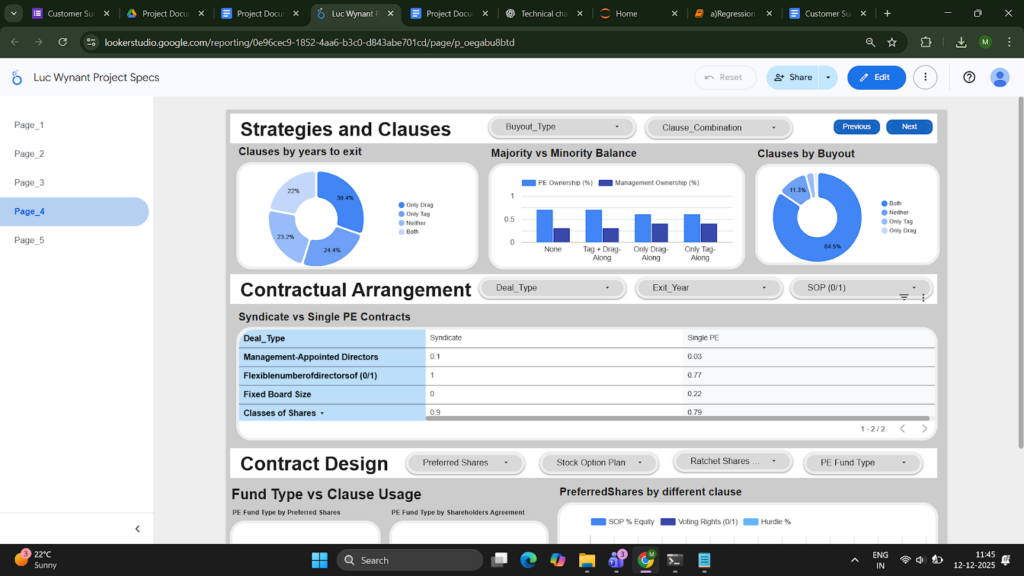
- By creating dashboards in Looker Studio, we aim to address the 10 key questions from our analysis. Each dashboard will highlight patterns in ownership, control rights, clauses, exits, and investor types. With filters and clear visuals, it will be easier to compare, explore, and understand contract designs across different deals.
- The dataset has three main problems. First, values are missing across many columns, which can affect the results. Second, some cells use error codes like -9999 instead of real values, which need to be fixed. Third, some columns have the wrong data types, like numbers saved as text, making analysis harder.
- Links :
Our Solution
We cleaned the dataset by removing all empty rows and columns to reduce noise and improve clarity. Data types were corrected and standardized for accurate filtering and analysis. We replaced all placeholder error codes with consistent missing values and filled in gaps using the median for numbers and the mode for categories. These steps made the dataset more reliable and easier to work with. This clean version allowed us to begin answering the 10 key analytical questions effectively.
Links:
- Project Overview(Analyzes and understanding project and dataset)
- Cleaned data(Raw data was cleaned, structured, and made ready for analysis)
- Research objectives (Focused on 10 key questions )
- Visualizations in Looker studio(Dashboards showing key insights)
Solution Architecture
- This project investigates how private equity (PE) contracts influence control rights, investor-manager alignment, governance mechanisms, transparency, and exit strategies. Using a detailed dataset sourced from Luc Wynant’s research, the analysis covers buyout deals.
- To make the insights actionable, all findings were transformed into interactive dashboards using Looker Studio. These dashboards feature bar charts, pie charts highlighting key patterns like clause frequency, ownership splits, governance structures, and exit performance. Dashboards are grouped into themes—control rights, transparency, alignment of interests, and exit outcomes—to support focused exploration of each research question.
- The final outputs include a cleaned and structured dataset, a suite of interactive dashboards, and a detailed report answering ten core questions about PE contract design and its implications for firm outcomes.
Deliverables
->Cleaned Dataset
->Exploratory Data Analysis report
->Regression Analysis Report
->Dashboard
Tech Stack
- Tools used
- Looker studio
- jupyter notebook
- Language/techniques used
- Python
- Models used
- pandas
- numpy
- statsmodels.api
- variance_inflation_factor
- warnings
- Workbook
- dataframe_to_rows
- Skills used
- Data cleaning & preprocessing
- Exploratory data analysis (EDA)
- Data transformation & normalization
- Pattern detection
- Predictive modelling
- Data visualization & dashboard creation
- Databases used
- https://docs.google.com/spreadsheets/d/1mo5okFMZ0pixkMmLCgOPtBpjoF0kKIU_/edit?rtpof=true
What are the technical Challenges Faced during Project Execution
- High Volume of Missing Data Across Key Variables
Many columns contained missing or incomplete values, making it difficult to compute accurate statistics, correlations, or regression models. Important dimensions such as ownership levels, control rights, and clause frequency suffered from incomplete entries. - Presence of Error Codes Like -9999 Masking True Values
Several numeric and categorical fields used placeholders such as -9999 or “.” to indicate data issues. These were incorrectly treated as valid values, affecting averages, distributions, and model outputs. - Inconsistent Data Types Across the Dataset
Numeric variables were stored as text, percentages were incorrectly formatted, and Boolean fields appeared in multiple inconsistent formats (0/1, Yes/No, TRUE/FALSE). This prevented smooth filtering, grouping, and modelling. - Lack of Standardization Across Contract Terms
Contract-related variables (e.g., veto rights, tag-along, drag-along) were recorded using different naming styles, making pattern detection and visualisation difficult. - Outliers and Skewed Distributions in Ownership & Financial Variables
Several variables showed extreme values that distorted regression and descriptive analysis, requiring careful inspection and transformation. - Complex Relationship Mapping Between Contract Clauses
Many clauses are interdependent (e.g., veto rights tied to board seats, tag-along tied to ownership %). Building clean models required restructuring the data to reflect these relationships. - Integration Challenges With Looker Studio
Looker Studio initially failed to read certain columns due to improper formatting and inconsistent data types. Visualisations also required model-ready tables, which the raw dataset couldn’t supply. - Ensuring Reproducibility Across Jupyter Notebook Workflows
Because data cleaning, EDA, and modelling were iterative, maintaining reproducible scripts, version control, and stable outputs required additional effort.
How the Technical Challenges were Solved
Systematic Missing Value Treatment
All missing values were profiled using a Missing Value Summary. Depending on the variable type:
- Numerical fields were imputed using median
- Categorical fields were imputed using mode
- Entirely empty rows/columns were dropped to reduce noise
Replacing Error Codes With Standardized Null Values
All occurrences of -9999, “.”, and empty text were converted into NaN using pandas’ replace functions. This allowed consistent handling of missingness during analysis.
Data Type Correction and Formatting
- Converted numeric strings into integer/float types
- Normalized percentages into decimal or numeric format
- Standardized Boolean fields to 0/1
This ensured compatibility with statistical models and Looker Studio.
Feature Standardization and Renaming
All clause-related fields were cleaned and renamed using a uniform structure, enabling easier aggregation and comparison across deals.
Outlier Detection and Transformation
- Boxplots and z-scores were used to identify outliers
- Extreme values were either capped (winsorized) or removed where necessary
This resulted in more stable regression coefficients and cleaner visual patterns.
Restructuring Contract Variables for Modelling
The dataset was reorganised to clearly link governance, ownership, and clause variables. Composite features were created where needed (e.g., “Number of Control Clauses”, “Level of Transparency”).
Creating Looker-Ready Clean Tables
A final, formatted dataset was exported specifically for Looker Studio, ensuring:
- Proper data types
- No error codes
- Flattened structure suitable for dashboards
Establishing a Reproducible Workflow
Jupyter Notebook scripts were modularised (data cleaning → EDA → modelling), allowing consistent reruns and documentation of each analytical step.
Business Impact
- Improved Understanding of Contract Design in PE Buyouts
The cleaned, structured dataset and visual dashboards provided clear insights into how investors design contracts to balance control, risk, and manager incentives. - Enhanced Decision-Making for Private Equity Firms
The ability to analyze relationships between ownership, control rights, transparency clauses, and exit outcomes supports better deal structuring and negotiation strategies. - Evidence-Based Governance and Alignment Recommendations
Findings help investors and managers understand which clauses reduce conflicts, increase alignment, and improve exit success, leading to more effective governance frameworks. - Benchmarking Across Investor Types
Insights on how banks, families, and independent PE funds differ in contract design allow practitioners to benchmark their own strategies against industry patterns. - Reduced Risk Through Better Contract Insights
Understanding derisking strategies and clause combinations enables firms to create contracts that minimize operational and financial exposure. - Faster, Clearer Analysis Through Dashboards
Stakeholders can explore patterns interactively, compare deals across dimensions, and identify outliers or best practices without manual analysis. - Academic Contribution to PE Contract Research
By answering ten core research questions with empirical evidence, the project strengthens the academic understanding of PE contracting mechanisms and their economic implications.
Project Snapshots
Project website url
https://lookerstudio.google.com/reporting/0e96cec9-1852-4aa6-b3c0-d843abe701cd/page/p_bddu4g1ctd
Project Video
Contact Details
This solution was designed and developed by Blackcoffer Team
Here are my contact details:
Firm Name: Blackcoffer Pvt. Ltd.
Firm Website: www.blackcoffer.com
Firm Address: 4/2, E-Extension, Shaym Vihar Phase 1, New Delhi 110043
Email: ajay@blackcoffer.com
WhatsApp: +91 9717367468
Telegram: @asbidyarthy