Introduction
Distributors connect manufacturers and suppliers with retailers, businesses, resellers, and end customers. Their operations may involve procurement, warehousing, inventory management, order processing, logistics, sales, credit management, and customer service.
Distributors operate in competitive markets where product availability, pricing, delivery speed, supplier reliability, and customer relationships directly affect profitability. They must balance inventory investment against demand uncertainty while managing supplier lead times, transportation costs, and fluctuating customer requirements.
Traditional distribution operations often rely on historical sales reports, manual purchasing decisions, spreadsheets, and disconnected business systems. Artificial Intelligence can help distributors transition toward predictive planning, intelligent order management, automated workflows, and data-driven commercial decisions.
By connecting purchasing records, inventory levels, customer orders, supplier performance, market signals, and financial data, AI can help distributors reduce stockouts, control working capital, increase sales, improve fulfillment, and strengthen profit margins.
10 AI Use Cases for Distributors
1. AI Demand Forecasting and Inventory Optimization
Distributors must maintain adequate stock to meet customer demand without tying up excessive capital in slow-moving inventory.
AI can analyze historical sales, seasonality, customer orders, promotions, supplier lead times, returns, and product-level trends to forecast future demand.
Applications include:
- SKU-level demand forecasting
- Seasonal demand prediction
- Safety-stock optimization
- Reorder-point recommendations
- Slow-moving inventory identification
- Stockout and excess-inventory prediction
- Multi-warehouse inventory balancing
For example, AI could identify a product that experiences recurring demand spikes during certain periods and recommend increasing stock ahead of the expected increase.
The system can also distinguish between temporary demand surges and sustained changes, helping purchasing teams avoid unnecessary overstocking.
Business impact: Better product availability, lower inventory carrying costs, and improved working capital utilization.
2. AI Procurement and Supplier Management
Distributor profitability depends heavily on purchasing prices, minimum order quantities, supplier reliability, delivery lead times, and payment terms.
AI can analyze purchase orders, supplier quotations, delivery records, quality issues, invoices, and demand forecasts to support procurement decisions.
Potential applications include:
- Supplier performance scoring
- Purchase requirement forecasting
- Procurement price anomaly detection
- Lead-time prediction
- Supplier risk assessment
- Purchase-order recommendations
- Supplier comparison and sourcing analysis
For example, AI could identify a supplier whose delivery times have become increasingly unreliable and recommend evaluating alternative sources before inventory shortages occur.
It can also help consolidate purchasing requirements across products and warehouses to reduce unnecessary orders and improve procurement planning.
Procurement decisions should follow approved supplier lists, contract terms, quality requirements, and purchasing authorization rules.
Business impact: More reliable sourcing, fewer procurement-related disruptions, and improved purchasing efficiency.
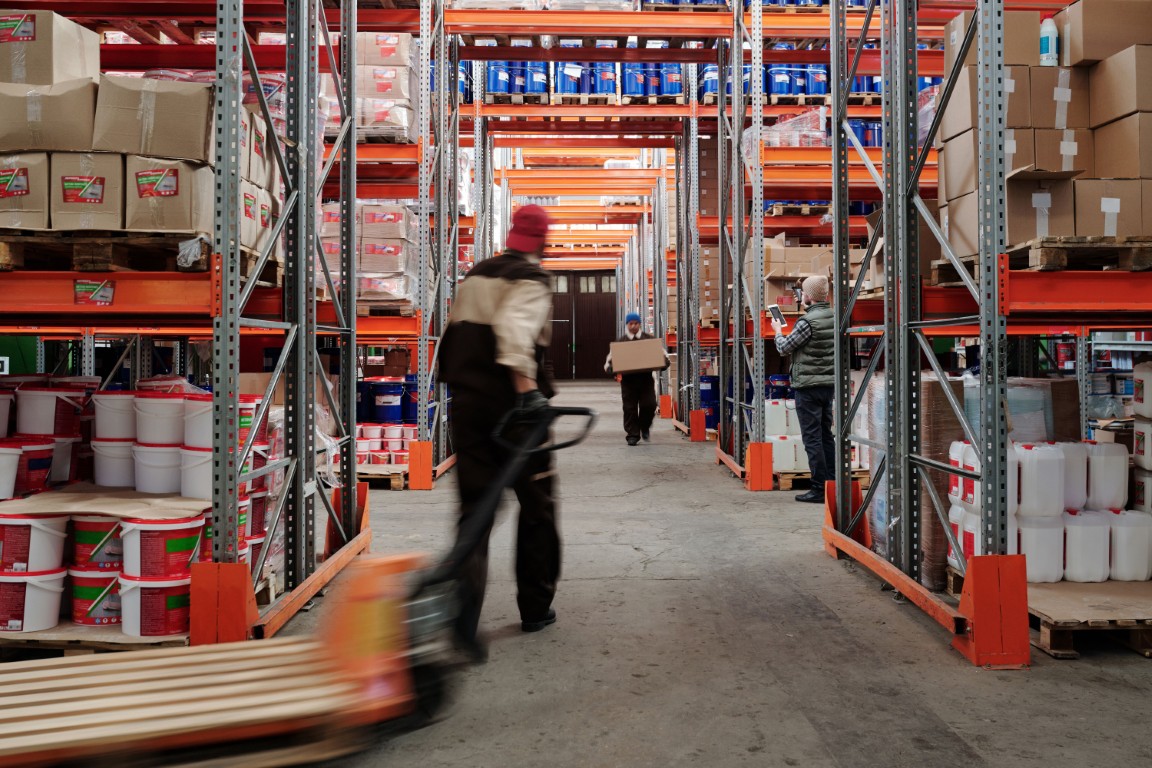
3. AI Warehouse and Order Fulfillment Optimization
Warehouses must receive, store, pick, pack, and dispatch large numbers of products accurately and efficiently.
AI can analyze order patterns, warehouse layouts, product dimensions, picking history, labor availability, and dispatch schedules to improve fulfillment decisions.
Applications include:
- Intelligent picking and packing recommendations
- Inventory slotting optimization
- Warehouse workload forecasting
- Order prioritization
- Labor and shift planning
- Picking-error detection
- Dispatch readiness prediction
For example, products frequently ordered together could be stored closer to one another, reducing unnecessary picking travel.
AI can also identify orders at risk of missing dispatch deadlines and help warehouse managers allocate resources accordingly.
Computer vision can support barcode validation, package inspection, and damage detection when suitable imaging and warehouse integrations are available.
Business impact: Faster order processing, fewer fulfillment errors, and improved warehouse productivity.
4. AI Sales Intelligence and Customer Relationship Management
Distributors often manage extensive customer portfolios across retailers, wholesalers, contractors, dealers, and business buyers.
AI can analyze purchase history, customer interactions, product preferences, order frequency, margins, and seasonal buying behavior to identify sales opportunities.
Applications include:
- Customer segmentation
- Purchase-pattern analysis
- Cross-selling and upselling recommendations
- Customer inactivity detection
- Sales opportunity prioritization
- Personalized product recommendations
- Sales representative performance analysis
For example, AI could identify a retailer that regularly purchases a core product but has never purchased a complementary item that similar customers frequently buy.
The sales team can use this insight to make a relevant recommendation instead of sending generic promotions.
AI can also identify customers whose order frequency has declined and help account managers investigate the cause.
Business impact: Higher sales conversion, improved customer retention, and increased revenue per account.
5. AI Pricing, Discounts and Profit Margin Optimization
Distributors often work with complex pricing structures involving volume discounts, negotiated rates, supplier rebates, promotions, freight expenses, and customer-specific contracts.
AI can analyze historical transactions, cost changes, demand, customer segments, competitor information where available, and product margins to support more informed pricing decisions.
Potential applications include:
- Margin analysis by product and customer
- Discount effectiveness measurement
- Price anomaly detection
- Quote recommendations
- Supplier rebate tracking
- Customer-specific pricing insights
- Profitability analysis by channel
For example, an AI system could flag products that generate substantial sales but consistently produce low margins after freight, discounts, and handling costs.
It could recommend reviewing discount policies, purchasing terms, or fulfillment costs before changing prices.
Pricing recommendations should respect customer contracts, applicable competition rules, and approved commercial policies.
Business impact: Better margin visibility, more disciplined discounting, and improved commercial profitability.
6. AI Logistics, Delivery Planning and Route Optimization
Distribution companies need to coordinate deliveries, carriers, fleet availability, delivery windows, fuel costs, and customer requirements.
AI can combine order data, vehicle capacity, warehouse locations, traffic information, delivery history, and dispatch constraints to recommend more efficient delivery plans.
Applications include:
- Delivery demand forecasting
- Route and stop-sequence optimization
- Vehicle capacity utilization
- Delivery delay prediction
- Carrier performance analysis
- Shipment consolidation
- Freight cost analysis
For example, AI could identify orders going to nearby customers that can be consolidated into one delivery run while meeting their delivery commitments.
It can also flag shipments likely to be delayed and help customer service teams communicate revised delivery expectations.
Actual routing should account for vehicle restrictions, operating hours, delivery windows, and real-world traffic conditions.
Business impact: Lower transportation costs, better delivery reliability, and more efficient fleet utilization.
7. AI Customer Service and B2B Ordering Automation
Distributors receive frequent inquiries about product availability, prices, order status, invoices, delivery dates, returns, and technical specifications.
AI assistants can answer routine questions by retrieving information from authorized ERP, inventory, CRM, and order management systems.
Potential applications include:
- AI customer service assistants
- Automated order status updates
- Product availability and specification lookup
- Quote preparation assistance
- Returns and claims intake
- Invoice and payment inquiry handling
- Guided B2B order placement
For example, a business customer could ask whether a specific item is available, receive the verified quantity and expected delivery date, and initiate an order through an approved workflow.
AI can also help sales representatives prepare quotations and find product alternatives when an item is unavailable.
Order submission, discount approval, credit overrides, and account changes should follow established authorization and validation procedures.
Business impact: Faster customer responses, fewer manual inquiries, and a more convenient buying experience.
8. AI Financial Planning, Credit Risk and Payment Collection
Distributors often operate with substantial accounts receivable, supplier obligations, credit limits, and cash tied up in inventory.
AI can analyze invoices, payment history, customer purchasing behavior, outstanding balances, credit exposure, and cash-flow patterns to help finance teams identify risks earlier.
Applications include:
- Late-payment risk prediction
- Accounts receivable prioritization
- Cash-flow forecasting
- Customer credit risk indicators
- Invoice discrepancy detection
- Payment reminder automation
- Working capital analysis
For example, AI could identify accounts whose payment patterns have deteriorated and recommend that the finance team review exposure before additional credit is extended.
It can also help identify invoice disputes that are delaying collection and route them to the appropriate team.
AI should support—not independently determine—material credit decisions. Credit limits, collection procedures, and payment terms should follow documented policies and appropriate human review.
Business impact: Better cash-flow visibility, more focused collection activity, and improved working capital management.
9. AI Product Intelligence, Returns and Quality Management
Distributors may handle thousands of products from multiple manufacturers, each with different specifications, compatibility requirements, warranties, and return conditions.
AI can analyze product catalogs, technical documents, customer feedback, return records, warranty claims, and quality reports to improve product information and identify recurring issues.
Potential applications include:
- Automated product data enrichment
- Product matching and substitution recommendations
- Duplicate SKU detection
- Return reason classification
- Warranty claim analysis
- Supplier quality monitoring
- Product compatibility assistance
For example, AI could identify a recurring return pattern for a product family and link it to a particular supplier batch, packaging issue, or product specification mismatch.
It can also help customers and sales representatives identify appropriate substitutes when a product is unavailable, subject to technical compatibility and supplier restrictions.
Business impact: Fewer avoidable returns, improved product data quality, and better supplier quality control.
10. AI Distributor Copilot and Business Analytics
Distributors need timely answers about stock availability, purchasing, profitability, order fulfillment, supplier performance, and customer demand.
An AI-powered distributor copilot can connect authorized business systems and translate operational data into practical explanations and recommendations.
A business owner might ask:
“Why did our gross margin decline this month?”
The AI could summarize evidence relating to supplier cost increases, discount levels, product mix, freight expenses, and customer profitability.
The owner could then ask:
“Which three actions should we prioritize?”
The assistant could recommend reviewing low-margin products, renegotiating selected supplier terms, or investigating excess freight costs.
A distributor analytics dashboard can track:
Sales
- Revenue by product and customer
- Average order value
- Sales growth and conversion
- Gross margin by channel
Inventory
- Inventory turnover
- Stockout frequency
- Days inventory outstanding
- Slow-moving and obsolete stock
Supply chain
- Supplier lead times
- On-time, in-full delivery
- Purchase price variance
- Warehouse fulfillment performance
Finance
- Accounts receivable
- Collection performance
- Cash-flow projections
- Profitability by product and customer
Operations
- Order processing time
- Picking and packing accuracy
- Delivery performance
- Returns and claims
The copilot should ground its explanations in verified business data, distinguish facts from estimates, and require suitable approvals for consequential purchasing, pricing, credit, and financial actions.
Business impact: Faster decision-making, improved visibility across departments, and more consistent operational management.
Potential Business Impact of AI for Distributors
The following are illustrative pilot targets, not guaranteed outcomes. Actual results depend on product complexity, transaction volumes, data quality, supplier relationships, and existing operational efficiency.
| Business Area | Illustrative Target |
|---|---|
| Inventory carrying costs | 5–15% reduction |
| Stockout incidents | 10–20% reduction |
| Manual order processing effort | 20–40% reduction |
| Warehouse picking and fulfillment errors | 10–25% reduction |
| Delivery planning and logistics costs | 5–15% reduction |
| Customer retention in targeted segments | 5–10% relative improvement |
| Accounts receivable follow-up effort | 15–30% reduction |
| Targeted cross-selling conversion | 3–8% improvement |
Distributors should establish baseline KPIs, run focused pilots, and validate outcomes through measurable changes in service levels, inventory investment, operating costs, and gross margin.
Recommended AI & Software Stack for Distributors
The following software covers procurement, inventory, warehouse operations, B2B sales, customer management, logistics, payments, analytics, and AI integration. Selection depends on the distributor’s industry, SKU volume, warehouse footprint, order channels, and existing business systems.
| Business Requirement | AI / Software | Use in Distributors | Website |
|---|---|---|---|
| Distribution ERP and business operations | Infor CloudSuite Distribution | Distribution-specific ERP, inventory, purchasing, order management, demand planning and analytics | Infor |
| Wholesale distribution ERP | NetSuite | Inventory, purchasing, finance, multi-location operations, order management and forecasting | NetSuite |
| Distribution ERP and sales operations | Epicor Prophet 21 | Distributor-focused inventory, order processing, pricing, purchasing and supply chain workflows | Epicor |
| Supply chain and procurement management | Microsoft Dynamics 365 Supply Chain Management | Demand planning, procurement, warehouse operations, fulfillment and AI-assisted supply chain workflows | Microsoft Dynamics 365 |
| Customer relationship management | Salesforce | Customer accounts, sales pipelines, account management and customer engagement | Salesforce |
| Warehouse and inventory execution | Microsoft Dynamics 365 Warehouse Management | Receiving, picking, packing, inventory movement and warehouse process automation | Dynamics 365 |
| B2B ecommerce and digital ordering | Shopify B2B | Business buyer storefronts, company accounts, wholesale catalogs and online order placement | Shopify B2B |
| Shipping and fulfillment | ShipStation | Shipment processing, shipping labels, carrier workflows and fulfillment visibility | ShipStation |
| Workflow automation | Make | Connect ERP, CRM, order management, customer notifications and reporting workflows | Make |
| AI and predictive analytics | Databricks | Demand forecasting, inventory analysis, customer intelligence and supply chain modeling | Databricks |
| Business intelligence | Microsoft Power BI | Sales, profitability, inventory, supplier and warehouse performance dashboards | Power BI |
| Cloud data warehouse | Snowflake | Consolidating sales, inventory, procurement, finance and logistics data for analytics | Snowflake |
| AI assistants and business intelligence | OpenAI | Internal knowledge assistants, document analysis, customer support and operational copilots | OpenAI |
| Custom integration and AI applications | Python and FastAPI | Develop custom forecasting services, AI APIs, product matching and business system integrations | FastAPI |
This is a modular reference stack rather than a requirement to deploy every product. Distributors should generally prioritize clean integrations with existing ERP, warehouse management, CRM, ecommerce, procurement, and finance systems before introducing additional platforms.
The AI-Powered Distribution Value Chain
AI can connect the complete distribution lifecycle, from sourcing products to fulfilling orders and collecting payments.
Suppliers and Procurement
Supplier evaluation, sourcing, purchase planning, lead-time prediction and supplier risk analysis
↓
Demand Planning and Inventory
Forecasting, replenishment, safety stock, warehouse allocation and stockout prevention
↓
Warehousing and Fulfillment
Receiving, storage, picking, packing, order prioritization and dispatch
↓
Sales and Customer Channels
Sales representatives, B2B ecommerce, wholesale portals, account management and product recommendations
↓
Pricing, Orders and Payments
Quotations, customer-specific prices, discount controls, order management, credit checks and collections
↓
Logistics and Delivery
Carrier selection, route planning, shipment tracking, delivery forecasting and freight analysis
↓
Returns and After-Sales Service
Claims, product replacements, warranty handling, quality feedback and customer support
↓
Data, AI and Automation Layer
Demand forecasting, predictive analytics, workflow integration, product intelligence and AI copilots
↓
Management and Continuous Improvement
Working capital, profitability, supplier performance, customer retention and operational efficiency
The objective is to give teams a connected view of the business so that procurement, inventory, sales, finance, and logistics decisions reinforce one another.
The Future of AI-Powered Distributors
AI is transforming distribution from a transaction-driven business into an increasingly predictive and customer-focused operating model.
Future capabilities may include:
- Autonomous replenishment within approved purchasing rules
- AI-powered B2B shopping assistants
- Predictive supplier and logistics risk management
- Dynamic inventory positioning across warehouses
- Automated product catalog enrichment
- Intelligent pricing and margin recommendations
- Computer vision for warehouse quality checks
- AI-assisted sales representatives and account managers
- Integrated cash-flow and working capital forecasting
- Natural-language business intelligence for managers
The greatest benefits will come from combining reliable transactional data with practical automation. AI recommendations should remain connected to real inventory availability, supplier commitments, delivery capabilities, contractual pricing, and financial controls.
The long-term objective is to create a distribution operation that is more responsive, efficient, customer-centric, and profitable.
How Blackcoffer Can Help Distributors
Blackcoffer helps organizations implement AI, data engineering, business intelligence, software integrations, and automation solutions.
For distributors, Blackcoffer can help develop:
- AI demand forecasting and inventory optimization
- Supplier performance and procurement analytics
- Warehouse and order fulfillment dashboards
- Customer intelligence and churn prediction
- AI sales assistants and product recommendation engines
- Pricing and gross-margin analytics
- Logistics and delivery optimization
- Payment collection and receivables analytics
- Product catalog matching and data enrichment
- AI customer service and B2B ordering assistants
- ERP, CRM, WMS and ecommerce integrations
- Distributor management copilots and executive dashboards
Our approach is straightforward:
Identify the highest-value business problem → Integrate the relevant data → Build a focused AI solution → Measure business impact → Scale what works.
Build an AI-Powered Distribution Business
Want to reduce inventory costs, improve order fulfillment, increase sales, optimize procurement, and strengthen distribution margins?
Blackcoffer can design and implement AI-powered solutions tailored to your distribution business, products, customers, and operating systems.
Contact
Are you seeking a similar solution?
Please reach me:
Email: ajay@blackcoffer.com
WhatsApp: +91 9717367468
LinkedIn: linkedin.com/in/asbidyarthy
Web Whatsapp: https://wa.me/919717367468